
Skip to content
  • Finnish Government
    • Prime Minister's Office
    • Ministry of Defence
    • Ministry of Transport and Communications
    • Ministry for Foreign Affairs
    • Ministry of Finance
    • Ministry of Economic Affairs and Employment
    • Ministry of Justice
    • Ministry of Education and Culture
    • Ministry of Social Affairs and Health
    • Ministry of the Interior
    • Ministry of Agriculture and Forestry
    • Ministry of the Environment

Valitse kieli:

This page is in Finnish. Go to the English site »

Or choose language:

Den här sidan är på finska. Gå till den svenska versionen av sidan »

Eller välj språk:

Dát siidu lea suomagillii Sirdás davvisámegielat siidduide »

Dehe vállje giela:

Taat sijđo lii suomâkielân Sirduu anarâškielâlijd sijđoid »

Tâi valjii kielâ:

Tät seidd lij lääʹddǩiõʹlle Sirddu lääʹddǩiõllsaž seiddõʹsse »

Leʹbe vaʹlljed ǩiõl:

Язык этого сайта финский. Перейти на русскоязычный сайт »

Или выберите язык:

Cette page est en finnois. Aller sur le site en français »

Ou choisir la langue:

Diese Seite ist auf Finnisch. Wechseln Sie zur deutschen Version »

Oder wählen Sie Ihre Sprache:

Tämä sivu on englanniksi. Siirry suomenkieliseen sivustoon »

Tai valitse kieli:

Choose language:

Den här sidan är på engelska. Gå till den svenska versionen av sidan »

Eller välj språk:

Dát siidu lea eŋgelasgillii Sirdás davvisámegielat siidduide »

Dehe vállje giela:

Taat sijđo lii eŋgâlâskielân Sirduu anarâškielâlijd sijđoid »

Tâi valjii kielâ:

Tät seidd lij eŋgglõsǩiõʹlle Sirddu lääʹddǩiõllsaž seiddõʹsse »

Leʹbe vaʹlljed ǩiõl:

Язык этого сайта английский. Перейти на русскоязычный сайт »

Или выберите язык:

Cette page est en anglais. Aller sur le site en français »

Ou choisir la langue:

Diese Seite ist auf Englisch. Wechseln Sie zur deutschen Version »

Oder wählen Sie Ihre Sprache:

Tämä sivu on ruotsiksi. Siirry suomenkieliseen sivustoon »

Tai valitse kieli:

This page is in Swedish. Go to the English site »

Or choose language:

Välj språk:

Dát siidu lea ruoŧagillii Sirdás davvisámegielat siidduide »

Dehe vállje giela:

Taat sijđo lii ruotâkielân Sirduu anarâškielâlijd sijđoid »

Tâi valjii kielâ:

Tät seidd lij ruõccǩiõʹlle Sirddu lääʹddǩiõllsaž seiddõʹsse »

Leʹbe vaʹlljed ǩiõl:

Язык этого сайта шведский. Перейти на русскоязычный сайт »

Или выберите язык:

Cette page est en suédois. Aller sur le site en français »

Ou choisir la langue:

Diese Seite ist auf Schwedisch. Wechseln Sie zur deutschen Version »

Oder wählen Sie Ihre Sprache:

Tämä sivu on pohjois-saameksi. Siirry suomenkieliseen sivustoon »

Tai valitse kieli:

This page is in North Saami. Go to the English site »

Or choose language:

Den här sidan är på nordsamiska. Gå till den svenska versionen av sidan »

Eller välj språk:

Vállje giela:

Taat sijđo lii tavesämikielân Sirduu anarâškielâlijd sijđoid »

Tâi valjii kielâ:

Tät seidd lij tâʹvvsääʹmǩiõʹlle Sirddu lääʹddǩiõllsaž seiddõʹsse »

Leʹbe vaʹlljed ǩiõl:

Язык этого сайта северосаамский. Перейти на русскоязычный сайт »

Или выберите язык:

Cette page est en same du Nord. Aller sur le site en français »

Ou choisir la langue:

Diese Seite ist auf Nordsamisch. Wechseln Sie zur deutschen Version »

Oder wählen Sie Ihre Sprache:

Tämä sivu on inarinsaameksi. Siirry suomenkieliseen sivustoon »

Tai valitse kieli:

This page is in Inari Sámi. Go to the English site »

Or choose language:

Den här sidan är på enaresamiska. Gå till den svenska versionen av sidan »

Eller välj språk:

Dát siidu lea anárašgillii Sirdás davvisámegielat siidduide »

Dehe vállje giela:

Valjii kielâ:

Tät seidd lij aanarsääʹmǩiõʹlle Sirddu lääʹddǩiõllsaž seiddõʹsse »

Leʹbe vaʹlljed ǩiõl:

Язык этого сайта инари-саамский. Перейти на русскоязычный сайт »

Или выберите язык:

Cette page est en sami inari. Aller sur le site en français »

Ou choisir la langue:

Diese Seite ist auf Inari Sámi. Wechseln Sie zur deutschen Version »

Oder wählen Sie Ihre Sprache:

Tämä sivu on koltansaameksi. Siirry suomenkieliseen sivustoon »

Tai valitse kieli:

This page is in Skolt Sámi. Go to the English site »

Or choose language:

Den här sidan är på skoltsamiska. Gå till den svenska versionen av sidan »

Eller välj språk:

Dát siidu lea nuortalašgillii Sirdás davvisámegielat siidduide »

Dehe vállje giela:

Taat sijđo lii nuorttâlâškielân Sirduu anarâškielâlijd sijđoid »

Tâi valjii kielâ:

Vaʹlljed ǩiõl:

Язык этого сайта скольт-саамский. Перейти на русскоязычный сайт »

Или выберите язык:

Cette page est en sámi skolt. Aller sur le site en français »

Ou choisir la langue:

Diese Seite ist auf Skolt Sámi. Wechseln Sie zur deutschen Version »

Oder wählen Sie Ihre Sprache:

Tämä sivu on venäjäksi. Siirry suomenkieliseen sivustoon »

Tai valitse kieli:

This page is in Russian. Go to the English site »

Or choose language:

Den här sidan är på ryska. Gå till den svenska versionen av sidan »

Eller välj språk:

Dát siidu lea ruoššagillii Sirdás davvisámegielat siidduide »

Dehe vállje giela:

Taat sijđo lii ruošâkielân Sirduu anarâškielâlijd sijđoid »

Tâi valjii kielâ:

Tät seidd lij ruõššǩiõʹlle Sirddu lääʹddǩiõllsaž seiddõʹsse »

Leʹbe vaʹlljed ǩiõl:

выберите язык:

Cette page est en russe. Aller sur le site en français »

Ou choisir la langue:

Diese Seite ist auf Russisch. Wechseln Sie zur deutschen Version »

Oder wählen Sie Ihre Sprache:

Tämä sivu on ranskaksi. Siirry suomenkieliseen sivustoon »

Tai valitse kieli:

This page is in French. Go to the English site »

Or choose language:

Den här sidan är på franska. Gå till den svenska versionen av sidan »

Eller välj språk:

Dát siidu lea fránskkagillii Sirdás davvisámegielat siidduide »

Dehe vállje giela:

Taat sijđo lii ranskakielân Sirduu anarâškielâlijd sijđoid »

Tâi valjii kielâ:

Tät seidd lij fraansk-ǩiõʹlle Sirddu lääʹddǩiõllsaž seiddõʹsse »

Leʹbe vaʹlljed ǩiõl:

Язык этого сайта французский. Перейти на русскоязычный сайт »

Или выберите язык:

Choisir la langue:

Diese Seite ist auf Französisch. Wechseln Sie zur deutschen Version »

Oder wählen Sie Ihre Sprache:

Tämä sivu on saksaksi. Siirry suomenkieliseen sivustoon »

Tai valitse kieli:

This page is in German. Go to the English site »

Or choose language:

Den här sidan är på tyska. Gå till den svenska versionen av sidan »

Eller välj språk:

Dát siidu lea duiskkagillii Sirdás davvisámegielat siidduide »

Dehe vállje giela:

Taat sijđo lii saksakielân Sirduu anarâškielâlijd sijđoid »

Tâi valjii kielâ:

Tät seidd lij saksslaǩiõʹlle Sirddu lääʹddǩiõllsaž seiddõʹsse »

Leʹbe vaʹlljed ǩiõl:

Язык этого сайта немецкий. Перейти на русскоязычный сайт »

Или выберите язык:

Cette page est en allemand. Aller sur le site en français »

Ou choisir la langue:

Wählen Sie Ihre Sprache:

  • Valitse kieli Suomi
  • Välj språket Svenska
  • Select language English
Media
Valtiovarainministeriö frontpage
Navigation
  • Frontpage
  • Areas of expertise
    • Economic Policy Budget, EU, international affairs
    • Economic Prospects Forecasts
    • Taxation Tax system and preparation
    • Financial Markets Stable and well functioning markets
    • Governance Policy Public management and structures
    • Local Government Affairs Finance, structures and cooperation
    • Wellbeing Services Counties Duties, other activieties and finances
    • Public Sector ICT Information policy and steering
    • Government as Employer Personnel and employer activity
  • Current issues
  • Projects and legislation
  • Publications
  • Ministry
  • Contact information
  • News archive
  • Russian Attack on Ukraine
  • Sustainable Growth Programme for Finland
  • Sign up for news
suomiLue artikkeli suomeksi svenskaLäs artikeln på svenska English

Education Policy Report: Equitable education of high quality essential for growing skills requirements and shrinking age cohorts in Finland
Ministry of Education and Culture
Publication date 8.4.2021 13.25
Type:Press release

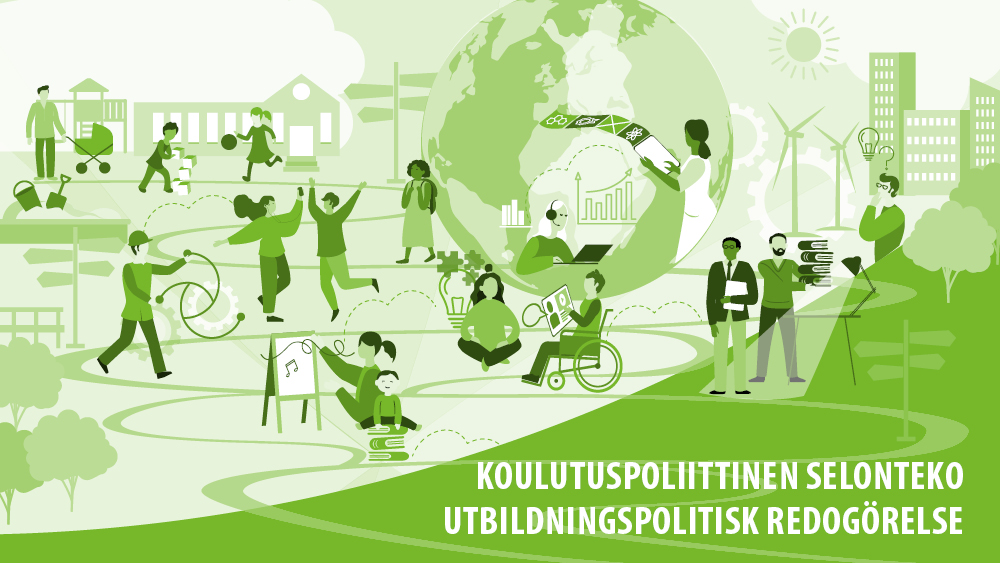
On Thursday 8 April, the Government submitted to Parliament a report on education policy. The Education Policy Report paves the way for equitable and high-quality education in the 2040s in Finland, where skills requirements are growing and age cohorts are shrinking. The report outlines the target state for education and research when moving forward to the 2040s and the necessary changes in resources, structures and guidance to achieve it.

The Government aims to use the Education Policy Report to set in motion a debate both in Parliament and broadly in society on the importance, problems and solutions of education and research in the future. The report is also intended to serve as the basis for future decision-making on education policy.

“Finland’s success has been based on the aim to ensure equal opportunities to acquire the necessary knowledge and skills in life. Educational equity is an asset we cannot afford to lose.  With the measures in the Education Policy Report, we want make sure our education system can continue to enable everyone's right to learn and grow to their full potential. That is the only way we can be successful in the future too,” said Minister of Education Jussi Saramo.

“It has been necessary to review Finnish education comprehensively. To respond to the big changes in our times, we need a common vision of how to develop education and research over parliamentary terms. The most important thing is to put people, learners, at the centre and to further step up interaction between education and the surrounding society, said Minister of Science and Culture Annika Saarikko.

Target state in 2040: Finland has a strong educational and cultural foundation

In the Education Policy Report, the goal the Government has set is that Finland will be a nation with a cultural and educational foundation in 2040 that draws on effective education, research and culture that are of high quality. Finland's international competitiveness and the wellbeing of its citizens build on this foundation.

The aim is that in 2040 educational equity and accessibility will have improved, and that Finland's level of education and competence will rank among the world's best. Education and research contribute to the achievement of sustainable development goals in society as a whole.

Selected items from the objectives and measures for education and research up to 2040:

Finnish society is facing major challenges: demographic changes and regional disparities, and rapid advances in the world of work and technology all demand new approaches and structures at all levels of education. Continuous learning, close cooperation between work and competence bring people protection in the event of restructuring and a competitive advantage for companies. 

To meet the challenges, the report proposes an overhaul of legislation and funding that would safeguard an equitable realisation of high quality for educational and cultural rights throughout the country. Legislation governing early childhood education and care, pre-primary education, primary and lower secondary education will be brought together into one clear package. It is proposed that funding for education be boosted by allocating the imputed savings from shrinking age cohorts to develop early childhood education and care and primary and lower secondary education. It is proposed that the financing system be amended to include needs-based funding, i.e. financing for positive discrimination. This will safeguard equity in learning. 

Safeguarding equitable education that is free of charge, of high quality and accessible will demand significant investment of public funds into education and research in the future. A higher level of education and competence can only be achieved with adequate resources for education and research and wiser allocation of resources. The report aims to achieve a commitment to investment in education that spans over parliamentary terms. Long-term financing that is predictable is a prerequisite for achieving the objectives set for education and research. The shortfall in learning and wellbeing caused by the COVID-19 epidemic must be fixed. Students of the coronavirus epoch must not become a lost generation of learning.

One of the objectives in the Education Policy Report is to reduce the fees charged for early childhood education and care. The long-term objective is to make early childhood education and care free of charge (a minimum of 4 hours a day).

Learning outcomes in primary and lower secondary education will be raised and learning disparities will be narrowed down by fostering wellbeing and inclusion in early childhood education and care and in school communities. This will be implemented by means of a new national binding model whereby school communities work collaboratively. Skills in literacy and numeracy will be strengthened and particular attention will be paid to developing the skills for critical thinking among children and young people.

General education will not be set against vocational education and training. Cooperation will be harnessed in upper secondary education and existing legislative or other obstacles in this area will be removed. In vocational education and training, general knowledge and basic skills will be strengthened, without undermining the acquisition of vocational competence. This way we can ensure that students have genuine opportunities for pursuing further studies and for upskilling during their working life. 

In upper secondary education, new technologies and practices will be harnessed to build personalised study paths for each learner. An apposite model of positive discrimination will also be developed for vocational education and training.

Projections show that in the future there will be a growing demand for tertiary-level expertise. One of the objectives is that by 2030 at least 50 per cent of all young adults in Finland will have completed a higher education degree. To achieve this, student intake in higher education institutions will be increased, without compromising the quality of education. The choices offered by higher education institutions will be developed on the basis of research. The aim is to triple the number of foreign degree students by 2030, and 75% of foreign graduates should find a job in Finland.

With regard to science, the aim is that in the future Finland will be an inspiring place to carry out research, and the research environments will be world class. Top talent will move to Finland and enhance Finland's skills level. Moreover, public research funding will also encourage private sector investment in expertise and RDI activities.

An important step towards achieving these goals is that the national RDI Roadmap (2020) be implemented effectively and to a high standard.

As part of higher education, the availability and competence of teachers and other staff in education and child care will be secured, by measures such as improving the knowledge base of staff members, by foresight and by the right scope of education and training, and by ensuring that the quality of education is based on research.

The report also outlines the development needs in areas such as liberal adult education, continuous learning, student financial aid, Swedish-speaking education, education for those with an immigrant background, learning for people with disabilities, and Saami education.

Education Policy Report (in Finnish)

Photos from the press conference (Flickr)

Inquiries:
Anita Lehikoinen, Permanent Secretary, tel. +358 29 5330 182
Petri Haltia, Ministerial Adviser, Ministry of Education and Culture, tel. +358 29 5330 096

Decision in Finnish Valtioneuvoston selonteko OKM/2021/21
Annika Saarikko Education Higher education and research Jussi Saramo Research Student financial aid Vocational education and training
decisions education and training education policy reports research science

See also

IMF recommends continued fiscal adjustments

Type:Press release Publication date:19.1.2026 10.01

Flexibility to be added to regulation of housing financing

Type:Press release Publication date:11.12.2025 14.12

New fiscal framework strengthens public finances

Type:Press release Publication date:13.11.2025 14.18

IMF praises Finland’s new fiscal framework

Type:Press release Publication date:10.11.2025 15.43

Finland submits Draft Budgetary Plan to European Union

Type:Press release Publication date:2.10.2025 15.27

Proposal for 2026 Budget submitted to Parliament

Type:Press release Publication date:22.9.2025 14.11
Valtiovarainministeriö frontpage Valtiovarainministeriö

Snellmaninkatu 1 A, Helsinki PO Box 28

FI-00023 Government, Finland

Tel. +358 295 16001

About the site

Data protection

Accessibility statement

Sitemap

Questions and feedback

  • Frontpage
  • Areas of expertise
    • Economic Policy
      • Starting points for economic policy
        • General government finances
        • Economic framework
        • Fiscal policy
        • Structural policy
      • Spending limits in central government finances and the budget
        • Central government spending limits
        • The budget
      • EU and the economy
        • European Semester
        • Fiscal rules
        • Budget
      • Assessment and monitoring of central government finances
        • Credit Ratings
        • International comparison of the Finnish economy
      • International Financial Affairs
        • Coalition for Climate Action
      • Discretionary government grants
    • Economic Prospects
      • Economic forecasts
        • Data on contingent liabilities
        • Revenue Working Group
        • Economic trends in construction
      • Descriptions of methods
      • Economic analyses
    • Taxation
      • Tax system
      • Personal taxation
        • Taxation of earned income
        • Taxation of capital income
        • Taxation at source on interest
        • Taxation of inheritance and gifts
        • Taxation of asset transfers
      • Business taxation
      • International income taxation
        • Co-operation in international taxation
        • Tax agreements
      • Real estate taxation
      • Value Added Tax
        • Tax on Insurance Premiums
      • Excise Duty
      • Road transport taxation
      • Customs
      • Tax expenditures
    • Financial Markets
      • Regulation of financial markets
        • Sanctions in the financial markets
        • New financial technologies
      • Stability and supervision
      • Government financial policy
      • Preventing money laundering and terrorist financing
        • Prevention
        • Legislation
    • Governance Policy
      • Openess, trust and ethics
      • Core principles and future of governance policy
        • Futures work and evaluations of governance policy
        • International activities
        • Proactive governance through anticipatory innovation
      • Public Service Leadership
        • Shared values and principles for public service leadership
        • Joint development and events
        • Position and service relationships of senior management
        • Leaders selection and career management
        • Preconditions for succeeding
        • Evidence-based management
        • Support for the senior management in central government
      • Structures, guidance and direction of administration
        • Central government
        • Municipal administration
        • Systems for guidance and direction
      • Management and steering of central government finances
        • Central government financial administration
      • Public services
      • Internal control and risk management
      • Shared government services
        • State properties
        • Government procurement
        • Financial and HR services
        • Education and training services
      • Public sector innovations
    • Local Government Affairs
      • Legislation on municipalities
        • Municipal structure
        • Local government employees
      • Local government’s duties and activities
        • Cooperation between the state and the municipalities
          • Advisory Committee on Local Government Finances and Administration
          • Evaluation of basic services
        • International cooperation
      • Local government finances
    • Wellbeing Services Counties
      • Functions and other activities
        • Counties and collaborative areas
        • Decision-making
        • Public participation
      • Funding and finances
        • Funding
        • Additional financing
        • Financial planning and monitoring
      • Steering
        • Negotiations with wellbeing services counties
        • Steering of investments
    • Public Sector ICT
      • Digitalisation
        • Digital services
        • Artificial intelligence and robotisation
          • Guidelines on using generative artificial intelligence to support and assist work in public administration
        • Digitalising and automating life and business events
          • Programme to promote life event based digitalisation
            • Questions and answers regarding life event based digitalisation
          • Easing the management of the affairs of a deceased relative
            • Frequently asked questions about the programme to ease the management of the affairs of a deceased relative
        • Priority of digital communications by public authorities
      • Information policy and steering
        • Information management map of public administration
        • Information policy report
        • Open data
        • Architectures
        • Project on redesigning the system of personal identity codes
        • Government policy programmes
          • Opening up and using public data
        • Steering of information management in public administration
          • Advisory boards on information management in public administration
        • Ethical Guidelines for AI in Public Administration
        • Interoperable Europe
      • Information security and cybersecurity
      • International cooperation on digitalisation and ICT
      • Information Management Board
    • Government as Employer
      • Collective Bargaining
        • Industrial peace
        • Agency-level collective bargaining 
        • Local union representatives
        • Occupational health and safety 
        • Cooperation
      • General collective agreements for government 
      • Terms and conditions of employment relationship
        • Pay, incentive schemes
          • Pay system in central government
          • Performance-related pay
          • Employees' mutual funds
        • Working hours
        • Annual leave
        • Official journeys
        • Absence
        • Benefits in kind
        • Occupational health care
      • Guidelines and regulations
      • Civil service law
      • Values and civil service ethics
        • Advisory Body on Civil Service Ethics
      • Support for personnel management
        • Central Government Human Resources Strategy
        • Personnel planning
        • Multi-location working in central government
        • Recruitment
        • Competence development
        • Personnel rotation and exchanges of public officials
        • Equality and equity
        • Tools and methods
        • Central government medals of merit for public officials
      • State personnel as statistics
  • Current issues
    • News archive
    • Russian Attack on Ukraine
    • Sustainable Growth Programme for Finland
      • Finland’s Recovery and Resilience Plan
        • Green transition
        • Digitalisation
        • Employment and skills
        • Health and social services
        • REPowerEU
      • Process
    • Sign up for news
  • Projects and legislation
    • Coordinating services and premises
      • Reshaping of regionalisation
      • Renewal of central government’s service and premises network in 2020s
        • Frequently asked questions about the renewal of the services and premises network
        • Regional progress of the reform
    • Project to implement the reformed eIDAS Regulation nationally
      • European Digital Identity Wallet
        • Questions and answers about the European wallet application
        • Piloting European Digital Identity Wallet
    • ProcurFinland – making public procurement more effective
      • National Public Procurement Data Repository
    • Coordination Group for Digitalisation
      • Advisory boards
      • Digital statutes in the EU
    • Development of internal control and risk management
    • Opening up and using public data
    • Project to implement the gambling system reform
    • Reform of regional state administration
    • Tourist tax
  • Publications
    • Web publications
      • Economic Survey, Autumn 2025
      • Economic Survey Winter 2025
  • Ministry
    • Task and objectives
    • Management and organisation
      • Ministers
        • Minister of Finance
        • Minister of Local and Regional Government
        • Minister of Economic Affairs
      • Management
      • Departments
    • Boards
      • Finnish Productivity Board
        • Board members
    • Ministry of Finance's branch of government
      • Agencies
      • State-owned companies and unincorporated State enterprises
      • Funds
    • Whistleblower protection
    • Ministry as a workplace
    • History
  • Contact information
    • Contact information and visiting address
    • Personnel search
    • Media and Communications Unit

Contact