
Renewal of central government’s service and premises network in 2020s
The central government’s in-person services will be brought together into joint customer service points, called Suomi-piste service points, and government agencies and public bodies will move into shared premises during the 2020s.
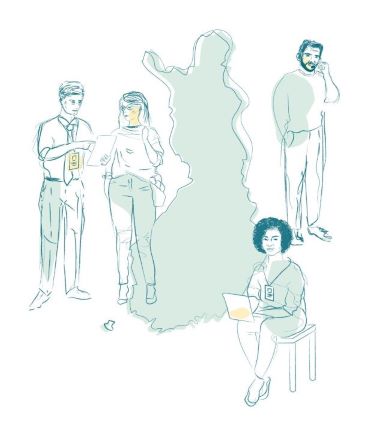
The aim of the service and premises network reform is to create a single shared customer service network for central government and Kela customers by 2030 and to reduce the number of premises in line with the central government premises strategy approved in December 2021. The aim of reshaping the network is to have a shared network for in-person services that will make customer service more customer-oriented, cost-effective and systematic.
The project involves the Digital and Population Data Services Agency, the Economic Development Centres, the Finnish Supervisory Agency, the Finnish Immigration Service, the National Land Survey of Finland, the National Legal Services Authority, the Police licence administration, the Community Sanctions Offices of the Prison and Probation Service of Finland, the National Enforcement Authority, the Finnish Tax Administration and, particularly with respect to customer service, the Social Insurance Institution of Finland Kela. Suomi-piste service points also aim to provide comprehensive access to local government services and certain wellbeing services county services that are suitable to being provided in joint service points.
The aim is that central government services should be provided comprehensively as e-services but also complemented by in-person services. The in-person visits of the future will focus on multi-sectoral services, digital support and use of remote services. By building Suomi-piste service points with municipalities and counties and by looking at the service network as a whole, it will be possible to ensure that in-person services are widely available and to improve the present level of service while also achieving cost savings.
The objective of the premises strategy is for a quarter of central government personnel to work in premises shared by different agencies and public bodies. In shared premises, employees of several government agencies work in the same premises. However, the needs and special characteristics of different kinds of work, for example with respect to data protection, will be taken into account, as will the current practice of mixing remote work and in-office work. The aim is to improve the efficiency of the use of premises from the current 18 square meters per person-year to 10. This will save costs and reduce energy consumption.
The need to reform the central government’s service and premises network in the 2020s is based on a number of factors: the growing supply and use of digital services and the resulting significant reduction in the number of visits to in-person services; an increase in multi-location working; demographic changes and urbanisation; and a diminishing level of financial resources. The increase in multi-location working and remote working has a significant impact on offices and the amount of office space required. New opportunities for using premises are presented if central government agencies can operate in joint facilities and if premises can be shared with municipalities, for instance.
What will the service and premises network project change?
- The in-person services provided by government agencies will gradually be assembled in joint customer service points, called Suomi-piste service points, which will also provide a wide range of municipal and Kela services as well as services of wellbeing services counties that are suitable for being provided in these service points.
- All citizens receive service within a one-hour drive from their homes.
- The range of services provided at service points will expand and become more consistent, and support will be available for the use of electronic services.
- A quarter of the personnel of government agencies and public bodies will move to work in shared, activity-based work environments.
Project status
2021: Service and premises network project established; implementation roadmap and regional project groups established in South Karelia, North Karelia and Päijät-Häme. Work begun on the national and regional level.
2022: Regional plans completed; national customer service and premises concepts completed; reports on the arrangement of joint government customer service activities and remote service solutions; preparation of pilot project for remote services.
2023: Preparation of tendering process for remote services; first premises projects in implementation areas completed.
2024: Interim project report I; regional work begun in South Savo, Central Finland, Pirkanmaa, Satakunta and Uusimaa; tendering process for remote services.
2025: Preparation of joint customer service tasks; piloting of remote services.
2026: Joint customer services tasks transferred to the Finnish Supervisory Agency; national launch of remote services.
2027: Interim project report II; obligation of public authorities to participate in Suomi-piste service points begins.
2030: Joint customer service network and policies of the premises strategy implemented throughout Finland; final report.
Frequently asked questions about the reform of the government service and premises network
Which government authorities does the reform concern?
The reform primarily involves the Digital and Population Data Services Agency, the Economic Development Centres, the Finnish Supervisory Agency, the Finnish Immigration Service, the National Land Survey of Finland, the National Legal Services Authority, the Police licence administration, the Community Sanctions Offices of the Prison and Probation Service of Finland, the National Enforcement Authority, the Finnish Tax Administration and the Social Insurance Institution of Finland Kela. Kela is involved in the reform particularly with respect to Suomi-piste service points. Other central government authorities that operate in a particular area participate in individual shared work environment projects on a location-by-location basis.
The reform is being carried out in close cooperation with municipalities and, as appropriate, wellbeing services counties.
Who is responsible for the reform?
The Ministry of Finance has set up and is leading the service and premises network project. The project is being prepared in cooperation between public authorities, the Finnish Supervisory Agency, Senate Properties and the Government ICT Centre Valtori.
The Ministry of Finance has appointed steering and preparation groups for the project. The steering group includes representatives of the ministries that guide the authorities involved, the Social Insurance Institution of Finland Kela, the Association of Finnish Cities and Municipalities, the Finnish Commerce Federation and personnel organisations. The members of the preparation group include representatives of the public authorities involved in the project and the Association of Finnish Cities and Municipalities.
There are also project sub-groups that are responsible for preparing the project’s national policies, for example, in relation to joint customer services and shared offices. The sub-groups include representatives of the public authorities participating in the project.
Project groups have been appointed for each region to design the service and premises network during 2021–2026. The project groups include representatives from the participating public authorities and the municipalities and county of the region in question. Each regional project group will draw up a regional plan defining the desired state for joint customer service points and offices in the region by 2030 and the phases required to achieve that state.
Senate Properties is responsible for leading and implementing shared work environment projects on a concrete level.
The Finnish Supervisory Agency will be responsible for the coordination and development of the network of Suomi-piste service points as of 1 January 2026.
I am a government official. Will I be able to work in any shared work environment in any city?
Shared work environments can be used by any public authorities that have signed an agreement on using the shared working environment in question. A shared work environment (in a regional city) can primarily be used by the personnel of the public authorities that have an office at that location. However, employers can sign an agreement to use a shared work environment even if the public authority in question has no other activities there. Shared work environments also have a few workstations for occasional use by other government employees.
It is important to note that a public official’s place of work and possibility for multi-location work is always decided by the employer.
Strategies guiding the project
The project for the renewal of the central government’s service and premises network in the 2020s implements the following strategies:
- Public governance strategy
- From regionalisation to regional presence strategy (in Finnish)
- Multi-location work strategy (in Finnish)
- Central government premises strategy (in Finnish)
More information:
Marko Puttonen, marko.puttonen(at)gov.fi
Jaana Salmi, jaana.salmi(at)gov.fi