Skip to content
  • Finnish Government
    • Prime Minister's Office
    • Ministry of Defence
    • Ministry of Transport and Communications
    • Ministry for Foreign Affairs
    • Ministry of Finance
    • Ministry of Economic Affairs and Employment
    • Ministry of Justice
    • Ministry of Education and Culture
    • Ministry of Social Affairs and Health
    • Ministry of the Interior
    • Ministry of Agriculture and Forestry
    • Ministry of the Environment

Valitse kieli:

This page is in Finnish. Go to the English site »

Or choose language:

Den här sidan är på finska. Gå till den svenska versionen av sidan »

Eller välj språk:

Dát siidu lea suomagillii. Sirdás davvisámegielat siidduide »

Dahje vállje giela:

Язык этого сайта финский. Перейти на русскоязычный сайт »

Или выберите язык:

Cette page est en finnois. Aller sur le site en français »

Ou choisir la langue:

Diese Seite ist auf Finnisch. Wechseln Sie zur deutschen Version »

Oder wählen Sie Ihre Sprache:

Tämä sivu on englanniksi. Siirry suomenkieliseen sivustoon »

Tai valitse kieli:

Choose language:

Den här sidan är på engelska. Gå till den svenska versionen av sidan »

Eller välj språk:

Язык этого сайта английский. Перейти на русскоязычный сайт »

Или выберите язык:

Dát siidu lea eŋgelasgillii. Sirdás davvisámegielat siidduide »

Dahje vállje giela:

Cette page est en anglais. Aller sur le site en français »

Ou choisir la langue:

Diese Seite ist auf Englisch. Wechseln Sie zur deutschen Version »

Oder wählen Sie Ihre Sprache:

Tämä sivu on ruotsiksi. Siirry suomenkieliseen sivustoon »

Tai valitse kieli:

This page is in Swedish. Go to the English site »

Or choose language:

Välj språk:

Язык этого сайта шведский. Перейти на русскоязычный сайт »

Или выберите язык:

Dát siidu lea eŋgelasgillii. Sirdás davvisámegielat siidduide »

Dahje vállje giela:

Cette page est en suédois. Aller sur le site en français »

Ou choisir la langue:

Diese Seite ist auf Schwedisch. Wechseln Sie zur deutschen Version »

Oder wählen Sie Ihre Sprache:

Tämä sivu on pohjois-saameksi. Siirry suomenkieliseen sivustoon »

Tai valitse kieli:

This page is in North Saami. Go to the English site »

Or choose language:

Den här sidan är på nordsamiska. Gå till den svenska versionen av sidan »

Eller välj språk:

Язык этого сайта северосаамский. Перейти на русскоязычный сайт »

Или выберите язык:

Vállje giela:

Cette page est en same du Nord. Aller sur le site en français »

Ou choisir la langue:

Diese Seite ist auf Nordsamisch. Wechseln Sie zur deutschen Version »

Oder wählen Sie Ihre Sprache:

Tämä sivu on venäjäksi. Siirry suomenkieliseen sivustoon »

Tai valitse kieli:

This page is in Russian. Go to the English site »

Or choose language:

Den här sidan är på ryska. Gå till den svenska versionen av sidan »

Eller välj språk:

Dát siidu lea ruoššagillii. Sirdás davvisámegielat siidduide »

Dahje vállje giela:

выберите язык:

Cette page est en russe. Aller sur le site en français »

Ou choisir la langue:

Diese Seite ist auf Russisch. Wechseln Sie zur deutschen Version »

Oder wählen Sie Ihre Sprache:

Tämä sivu on ranskaksi. Siirry suomenkieliseen sivustoon »

Tai valitse kieli:

This page is in French. Go to the English site »

Or choose language:

Den här sidan är på franska. Gå till den svenska versionen av sidan »

Eller välj språk:

Dát siidu lea fránskkagillii. Sirdás davvisámegielat siidduide »

Dahje vállje giela:

Язык этого сайта французский. Перейти на русскоязычный сайт »

Или выберите язык:

Choisir la langue:

Diese Seite ist auf Französisch. Wechseln Sie zur deutschen Version »

Oder wählen Sie Ihre Sprache:

Tämä sivu on saksaksi. Siirry suomenkieliseen sivustoon »

Tai valitse kieli:

This page is in German. Go to the English site »

Or choose language:

Den här sidan är på tyska. Gå till den svenska versionen av sidan »

Eller välj språk:

Язык этого сайта немецкий. Перейти на русскоязычный сайт »

Или выберите язык:

Cette page est en allemand. Aller sur le site en français »

Ou choisir la langue:

Wählen Sie Ihre Sprache:

  • Valitse kieli Suomi
  • Välj språket Svenska
  • Select language English
Media
Valtiovarainministeriö frontpage
Navigation
  • Frontpage
  • Areas of expertise
    • Economic Policy Budget, EU, international affairs
    • Economic Prospects Forecasts
    • Taxation Tax system and preparation
    • Financial Markets Stable and well functioning markets
    • Governance Policy Public management and structures
    • Local Government Affairs Finance, structures and cooperation
    • Wellbeing Services Counties Duties, other activieties and finances
    • Public Sector ICT Information policy and steering
    • Government as Employer Personnel and employer activity
  • Current issues
  • Projects and legislation
  • Publications
  • Ministry
  • Contact information
  • News archive
  • Russian Attack on Ukraine
  • Securing daily payments
  • Sustainable Growth Programme for Finland
  • Nordic cooperation
  • Sign up for news
suomiLue artikkeli suomeksi svenskaLäs artikeln på svenska English

Government proposal
Individual services to support job search in the Nordic labour market service model

Ministry of Economic Affairs and Employment
Publication date 7.10.2021 13.43
Type:Press release
Nordic labour market service model combines an assessment of individual service needs, intensive support for job search and other services, and job search on own initiative.

The reform would give unemployed jobseekers quicker and more intensive support for their job search. The Government submitted a proposal on the Nordic labour market service model to Parliament on 7 October 2021. The changes are intended to take effect in May 2022.

“The Nordic labour market service model is one of the Government’s measures to reform jobseeker services. Research shows that individual and effective services shorten periods of unemployment. Until now, Finland has lagged behind the other Nordic countries in terms of the quantity and quality of employment services. We will correct this now,” says Minister of Employment Tuula Haatainen.

The Nordic labour market service model is estimated to increase employment by about 9,500–10,000 people. The impact on employment would be fully achieved from the beginning of 2025.

In particular, the discussions organised every two weeks at the start of the job search are expected to support employment. Based on research, regular interaction with jobseekers, active employment services and job search monitoring will shorten the periods of unemployment.

In order to enable individual services, the Government will increase the resources of TE Offices and municipalities by EUR 70 million. With this money, they will recruit about 1,200 new specialists.

Quick and intensive support for job search

In the Nordic labour market service model, the first meeting between a jobseeker and a specialist would take place within five working days of the start of job search. After this, jobseekers would receive more intensive support for their job search than currently. In the early stages of job search, the jobseeker would meet a specialist from the TE Office or the participating municipality every two weeks.

During the meetings, the jobseekers’ need for services, their skills and ability to look for work would be individually assessed. If the skills to look for work or to be employed were found to be lacking, the jobseeker would get access to services quicker. 

If there was no need to improve these skills, the jobseeker would have to apply for four jobs per month. However, exceptions could be made, for example, if the jobseeker’s working capacity had deteriorated or there were only few vacancies available in the area.

Modern job search instead of purposeless applications

Jobseekers would still have to apply for work in order to receive unemployment benefits, but they could influence their job search more. In principle, jobseekers would select the job opportunities they apply for, but a specialist would support jobseekers in finding suitable jobs. As a rule, jobseekers would report on their job search through an online service.

For example, submitting a job application for a vacancy or submitting an open job application to a company that is not actively hiring would be considered applying for a job. Jobseekers should apply for jobs they could reasonably assume to get.

Reasonable sanctions for failing to apply for jobs

Looking for work has always been a precondition for receiving unemployment benefit. Currently, failure by a jobseeker to apply for a job offered to them results in a temporary loss of unemployment benefit, i.e. a sanction. These consequences have been considered unreasonable.

In the Nordic labour market service model, the sanctions for failing to apply for work would become more reasonable. A jobseeker would receive a reminder in the first case of forgetfulness or neglect. In addition, the periods of sanction when the unemployment benefits are not paid would be staggered and shortened.

Inquiries:
Iiris Niinikoski, Special Adviser to the Minister of Employment, tel. +358 295 047 372 
Timo Meling, Senior Ministerial Adviser, Ministry of Economic Affairs and Employment, tel.  +358 295 049 084 (unemployment security)
Ahti Avikainen, Senior Specialist, Ministry of Economic Affairs and Employment, tel. +358 295 047 980 (TE Services)
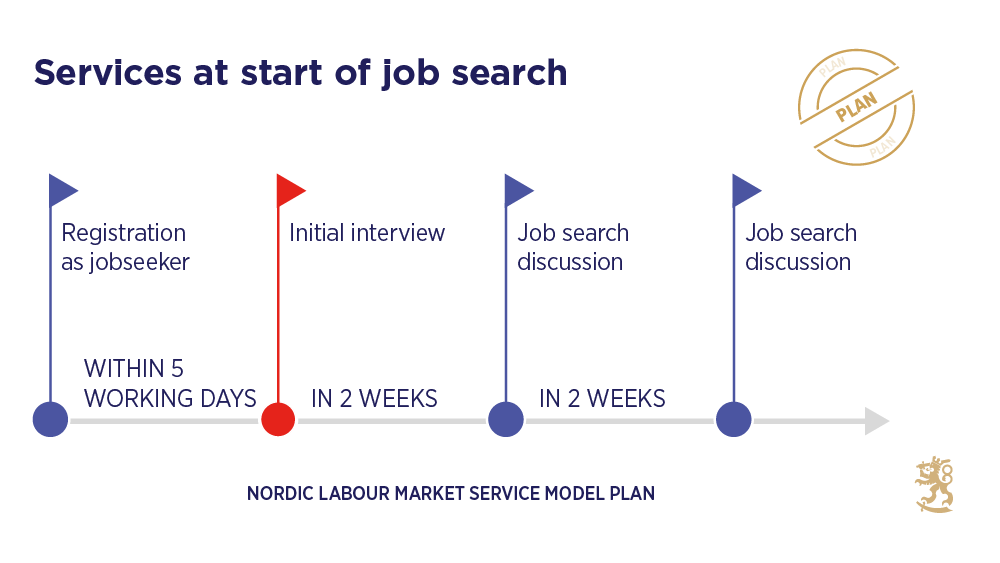
The graphic shows services at start of job search. The first meeting will take place within five working days. Job search discussions are then held every two weeks.

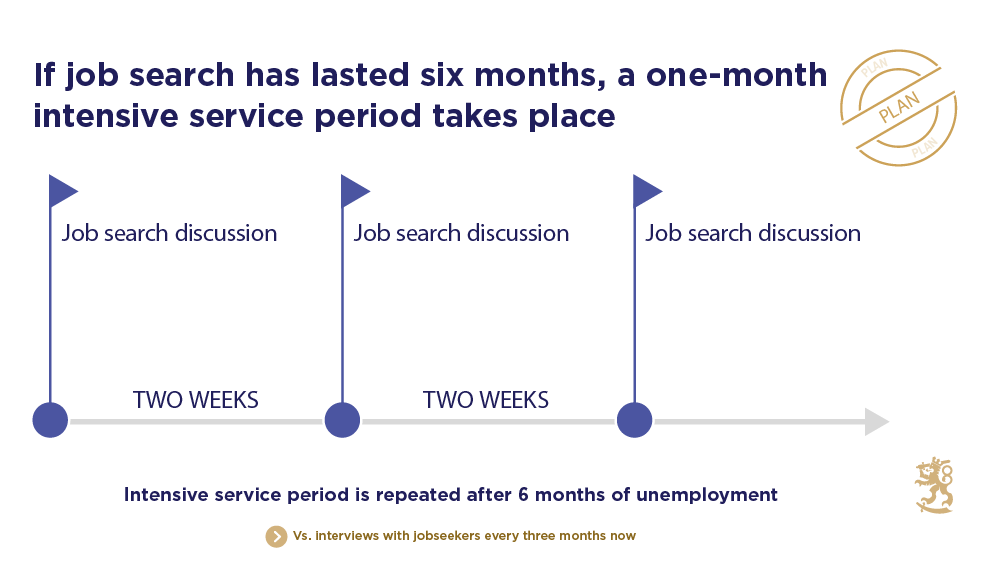
The graphic shows the services during the first three months of job search. Job search discussions are then held every two weeks. Now interviews with jobseekers are held every three months.

The graphic shows the services if job search has lasted six months. A one-month intensive service period with job search discussions every two weeks takes place. Now interviews with jobseekers are held every three months.

Questions and answers about the Nordic labour market service model
Decision in Finnish Hallituksen esitys TEM/2021/163
The PowerPoint presentation showed at the press conference (in Finnish)
Tuula Haatainen
Nordic countries TE services administrative areas decisions employment employment services job application legislation municipalities services services work working life

See also

Nordic and Baltic ministers for digitalisation meet in Tampere

Type:Press release Publication date:5.11.2025 14.00

Proposal for 2026 Budget submitted to Parliament

Type:Press release Publication date:22.9.2025 14.11

Economy recovering slowly, debt ratio set to stabilise briefly

Type:Press release Publication date:22.9.2025 11.09

Government decides on General Government Fiscal Plan for 2026–2029

Type:Press release Publication date:30.4.2025 13.34

A trade war poses a threat to Finland’s economic recovery and its already fragile general government finances 

Type:Press release Publication date:30.4.2025 11.02

Government proposes second term for Olli Rehn as Bank of Finland Governor

Type:Press release Publication date:13.3.2025 13.28
Valtiovarainministeriö frontpage Valtiovarainministeriö

Snellmaninkatu 1 A, Helsinki PO Box 28

FI-00023 Government, Finland

Tel. +358 295 16001

About the site

Data protection

Accessibility statement

Sitemap

Questions and feedback

  • Frontpage
  • Areas of expertise
    • Economic Policy
      • Starting points for economic policy
        • General government finances
        • Economic framework
        • Fiscal policy
        • Structural policy
      • Spending limits in central government finances and the budget
        • Central government spending limits
        • The budget
      • EU and the economy
        • European Semester
        • Fiscal rules
        • Budget
      • Assessment and monitoring of central government finances
        • Credit Ratings
        • International comparison of the Finnish economy
      • International Financial Affairs
        • Coalition for Climate Action
      • Discretionary government grants
    • Economic Prospects
      • Economic forecasts
        • Monthly data on public finances and data on contingent liabilities
        • Revenue Working Group
        • Economic trends in construction
      • Descriptions of methods
      • Economic analyses
    • Taxation
      • Tax system
      • Personal taxation
        • Taxation of earned income
        • Taxation of capital income
        • Taxation at source on interest
        • Taxation of inheritance and gifts
        • Taxation of asset transfers
      • Business taxation
      • International income taxation
        • Co-operation in international taxation
        • Tax agreements
      • Real estate taxation
      • Value Added Tax
        • Tax on Insurance Premiums
      • Excise Duty
      • Road transport taxation
      • Customs
      • Tax expenditures
    • Financial Markets
      • Regulation of financial markets
        • Sanctions in the financial markets
        • New financial technologies
      • Stability and supervision
      • Government financial policy
      • Preventing money laundering and terrorist financing
        • Prevention
        • Legislation
    • Governance Policy
      • Openess, trust and ethics
      • Core principles and future of governance policy
        • Futures work and evaluations of governance policy
        • International activities
        • Proactive governance through anticipatory innovation
      • Public Service Leadership
        • Shared values and principles for public service leadership
        • Joint development and events
        • Position and service relationships of senior management
        • Leaders selection and career management
        • Preconditions for succeeding
        • Evidence-based management
        • Support for the senior management in central government
      • Structures, guidance and direction of administration
        • Central government
        • Municipal administration
        • Systems for guidance and direction
      • Management and steering of central government finances
        • Central government financial administration
      • Internal control and risk management
      • Shared government services
        • State properties
        • Government procurement
        • Financial and HR services
        • Education and training services
      • Public sector innovations
    • Local Government Affairs
      • Legislation on municipalities
        • Municipal structure
        • Local government employees
      • Local government’s duties and activities
        • Cooperation between the state and the municipalities
          • Advisory Committee on Local Government Finances and Administration
          • Evaluation of basic services
        • International cooperation
      • Local government finances
    • Wellbeing Services Counties
      • Duties and other activities
        • Wellbeing services counties
        • Cooperation
        • Decision-making
        • Guidance
        • Opportunities to influence and participate
      • Finances of the wellbeing services counties
        • Funding
        • Additional funding
        • Budget and financial plan
        • Investments
      • Negotiations with wellbeing services counties
    • Public Sector ICT
      • Digitalisation
        • Digital services
        • Artificial intelligence and robotisation
          • Guidelines on using generative artificial intelligence to support and assist work in public administration
        • Digitalising and automating life and business events
          • Programme to promote life event based digitalisation
            • Questions and answers regarding life event based digitalisation
          • Easing the management of the affairs of a deceased relative
            • Frequently asked questions about the programme to ease the management of the affairs of a deceased relative
        • Priority of digital communications by public authorities
      • Information policy and steering
        • Information management map of public administration
        • Information policy report
        • Open data
        • Architectures
        • Project on redesigning the system of personal identity codes
        • Government policy programmes
          • Opening up and using public data
        • Steering of information management in public administration
          • Advisory boards on information management in public administration
        • Ethical Guidelines for AI in Public Administration
        • Interoperable Europe
      • Information security and cybersecurity
      • International cooperation on digitalisation and ICT
      • Information Management Board
    • Government as Employer
      • Collective Bargaining
        • Industrial peace
        • Agency-level collective bargaining 
        • Local union representatives
        • Occupational health and safety 
        • Cooperation
      • General collective agreements for government 
      • Terms and conditions of employment relationship
        • Pay, incentive schemes
          • Pay system in central government
          • Performance-related pay
          • Employees' mutual funds
        • Working hours
        • Annual leave
        • Official journeys
        • Absence
        • Benefits in kind
        • Occupational health care
      • Guidelines and regulations
      • Civil service law
      • Values and civil service ethics
        • Advisory Body on Civil Service Ethics
      • Support for personnel management
        • Central Government Human Resources Strategy
        • Personnel planning
        • Multi-location working in central government
        • Recruitment
        • Competence development
        • Personnel rotation and exchanges of public officials
        • Equality and equity
        • Tools and methods
        • Central government medals of merit for public officials
      • State personnel as statistics
  • Current issues
    • News archive
    • Russian Attack on Ukraine
    • Securing daily payments
    • Sustainable Growth Programme for Finland
      • Finland’s Recovery and Resilience Plan
        • Green transition
        • Digitalisation
        • Employment and skills
        • Health and social services
        • REPowerEU
      • Process
    • Nordic cooperation
      • Nordic Council of Ministers for Digitalisation
      • World’s smoothest cross-border mobility and daily life through digitalisation
    • Sign up for news
  • Projects and legislation
    • Coordinating services and premises
      • Reshaping of regionalisation
      • Renewal of central government’s service and premises network in 2020s
        • Frequently asked questions about the renewal of the services and premises network
        • Regional progress of the reform
    • Project to implement the reformed eIDAS Regulation nationally
      • European Digital Identity Wallet
        • Questions and answers about the European wallet application
        • Piloting European Digital Identity Wallet
    • ProcurFinland – making public procurement more effective
      • National Public Procurement Data Repository
    • Coordination Group for Digitalisation
      • Advisory boards
      • Digital statutes in the EU
    • Development of internal control and risk management
    • Opening up and using public data
    • Project to implement the gambling system reform
    • Reform of regional state administration
  • Publications
    • Web publications
      • Economic Survey, Autumn 2025
      • Economic Survey Winter 2025
  • Ministry
    • Task and objectives
    • Management and organisation
      • Ministers
        • Minister of Finance
        • Minister of Local and Regional Government
        • Minister of Economic Affairs
      • Management
      • Departments
    • Boards
      • Finnish Productivity Board
        • Board members
    • Ministry of Finance's branch of government
      • Agencies
      • State-owned companies and unincorporated State enterprises
      • Funds
    • Whistleblower protection
    • Ministry as a workplace
    • History
  • Contact information
    • Contact information and visiting address
    • Personnel search
    • Media and Communications Unit

Contact